Bayern Munich have successfully established themselves as a
European superpower over the past half-decade. They appear to have withstood
the Dortmund revolution and are certain to claim a 3rd successive
Bundesliga trophy. After the treble success of 2013, it would have been hard
for any man to follow on from the success of Jupp Heynckes. However if any man
could, you would have fancied Pep Guardiola to at least give it a good go.
Nearly three years on, has Pep actually made Bayern a better team?
 |
| Dry your eyes Jurgen |
Domestically Bayern have been nothing short of dominant
under Guardiola, and their 2013/2014 campaign was essentially Blitzkreig. In
his first season they won the league in record time with 7 games to spare, and
they amassed a ridiculous unbeaten run of 53 games. This year they’re 14 points
clear so only the blackest of magic can stop them
retaining the title. Add to the equation, a German Cup last season and a pending
semi-final appearance this year and everything looks rosy in Bavaria. However,
domestic dominance is the minimum requirement for Bayern Munich – especially considering
Guardiola took over a treble winning team. That task was arguably made easier
considering that Bayern took the two best players from their closest rivals
during Guardiola’s tenure. I’m not by any means suggesting that it was an easy
job, but the goals were widened slightly.
On the European front have Bayern regressed? En route to
their Wembley triumph in 2013 they had the minor task of facing Barcelona in
the semis, resulting in an emphatic 7-0 aggregate decimation of the Catalan
club. The following season, the tables were well and truly turned as Bayern
succumbed to a 5-0 aggregate defeat at the hands of Real Madrid, who went on to
win La Decima. Retaining the Champions League is incredibly difficult which is
why it’s unprecedented. Failure to do so isn’t shameful. But for the holders to
be so roundly beaten by opponents that they beat the previous year suggests
that Bayern had slipped a little from the high standards they had set for
themselves.
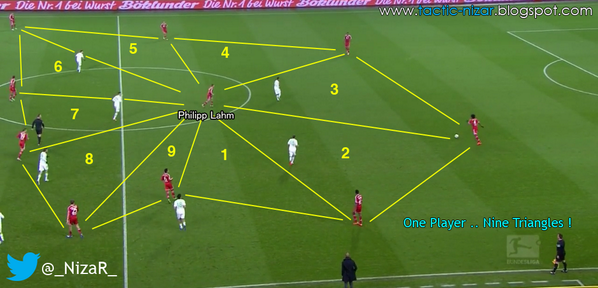 |
| The Phillip Lahm role in action |
Watching Bayern is often perplexing, as at times it seems
that Guardiola is needlessly trying to reinvent the wheel. Phillip Lahm has
consistently been one of the best full backs in the world over the past decade,
but he’s been used as a holding midfielder for much of Guardiola’s reign, as
has David Alaba on multiple occasions. A manager has to make his own mark on a
team that he takes over, but is that not going overboard? Why
allow a world
class midfielder like Toni Kroos to leave if you’re going to replace him with
defenders? Sanding off the edges of a square peg to fit into a round hole is surely
much harder than finding another round peg.
The false 9 position is something I’ve credited Guardiola
with, as it allowed Messi to reach herculean levels. However Thomas Muller is
not now and never will be Lionel Messi. Robert Lewandowski arrived at Bayern
after finishing as top scorer in the Bundesliga, and he has had to be
comfortable with a substitute berth on many occasions this season. A world
class number 9 quite often being left out to accommodate a false 9 – doesn’t
quite add up. It all stems from Guardiola’s desire to play the tika-taka
football ingrained in his DNA. A style of play which has had its weaknesses
exploited to devastating effect in the past – not least by Bayern themselves.
It’s hard to imagine a bigger test for Guardiola’s Bayern side than a Champions League semi-final tie against Barcelona. Critics came out in full force as Bayern slipped to a 3-1 quarter final first leg defeat to Porto, to which they responded with a 6-1 thrashing in the return leg. We aren’t going to learn anything new about Bayern through their league performance, so this will be the best chance to see just how far this team has come under the Spaniard. Are they anywhere close to the 2013 treble winners? Or has Pep taken them backwards in order to go forwards?

Comments
Post a Comment