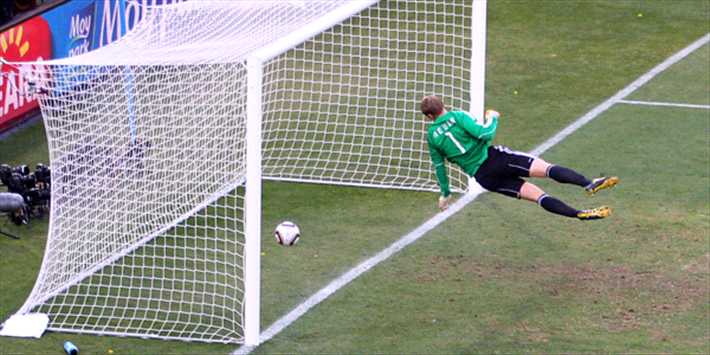
Bloemfontein, South Africa, 2010. England trail Germany 2-1
in the last 16 of the World Cup. The momentum is with us. Lampard takes a
shot...I’m sure you don’t need reminding of what happened next. A whole nation
is left outraged. Not even my born and raised Nigerian mother can hide her
anger. England end up getting spanked 4-1, and are dumped out of the World Cup
amid vociferous cries for technology to be introduced into football.
 |
| It's not even close |
4 YEARS TOO LATE, goal line technology is trialled at the
Confederations Cup, and then introduced into parts of football thereafter
(overshadowing the arrival of the Magic Spray). Although not yet used by all
major European leagues, the Premier League has definitely seen the benefit of
the technology. Gone are the days of debate
, and
teams have one less thing to complain about. But as it happens, as soon as one
problem is solved another arises.  |
| 'Tis but a scratch |
The Matic/Barnes altercation recently sparked cries for
video technology to be introduced into football as an aide for referees. In theory
it sounds like a great idea but I can see problems. Let’s take that incident at
Stamford Bridge as an example. It goes without saying that it was an absolutely
horrible tackle, and Matic was more than justified to react in the way that he
did. However he was the only player on the pitch to see the challenge for what
it was. Everybody else on the pitch was preparing for a Burnley throw in. So in
that scenario would there be any need to video refer? If nobody sees anything
wrong with an incident – including the referee – then there would be no need
for video referral and the crime goes unpunished. There can be retrospective
punishment for the offending player, but that does little to effect proceedings
in the actual match.
Secondly, decisions can still be open to interpretation. With
goal line technology, the ball has either crossed the line or it hasn’t. Other
decisions aren’t so simple. One man’s deliberate handball can be another man’s ball
to hand. I don’t believe it to be beyond the realms of possibility for a ref to
see footage again and still get the decision wrong, thus making video
technology redundant. When it all comes down to it, he is still the one in
charge of making the decisions, and no amount of technology can eliminate human
error.
Also, who decides which incidents are reviewed and which
aren’t? Who’s throw in was that? Is that a goal kick or a corner? Was it inside
the box? Did he dive? Was he offside? Was he in the goalkeeper’s eye line? Was he
interfering with play? Did he head-butt him? Who spat at who? There are so many
50/50 decisions that need to be made during the course of a match. Are some
more important than others? If so, who decides that? Do all incidents need
video referrals? How long would that take? God forbid football adopts the
painful stop-start nature of American football, which is the sole reason I haven’t
stayed awake until half time of any of the last three Superbowls I’ve tried to
watch.
 |
| Howard Webb did a great job in South Africa |
Video technology will not provide a quick fix for poor
refereeing. Incidents in recent weeks have led people to believe that the
standard of refereeing in England is inherently poor, which is not the case. Let’s
not forget that it was a team of English officials which oversaw the 2010 World
Cup final. By introducing more and more technology into football, wouldn’t the
standard of refereeing decline?
Surely giving referees more crutches would mean
that they never learn to walk properly on their own.
Introducing video technology into football has the potential
to be a logistical nightmare. However as Rugby has shown, it has the potential
to be an invaluable resource in the game. The issue was taken to football’s
lawmakers IFAB (International FA Board), who decided to delay trials for
another year, suggesting that they also found some issue with it. If executed
properly, the benefits are obvious despite any problems that may come with it.
It may not seem to be the most urgent matter in football, but FA chairman Greg
Dyke’s comments strike true: let's not wait for another Frank Lampard
disallowed goal to happen before doing something.
Comments
Post a Comment